Seeing chimpanzees in the wild is an unforgettable experience for any nature lover. These primates are found across many African countries, ranging from Senegal in the west to Tanzania in the east. However, in most places, spotting chimpanzees is extremely difficult. In recent years, Kibale National Park in Uganda has become one of the best places in the world to see wild chimpanzees.
Kibale National Park protects a lush tropical rainforest covering around 770 km². The dense vegetation that blankets this area makes navigation and wildlife observation quite a challenge. Over 1,200 chimpanzees live within the park’s boundaries. And although they are the park’s most iconic inhabitants, there are many more species in this forest: up to 13 species of primates have been recorded, along with over 300 bird species and mammals such as elephants, buffalos, and leopards.
To see chimpanzees in Kibale National Park in a responsible and safe way, you need to book a permit for the chimpanzee trekking activity.

What Is Chimpanzee Trekking in Kibale National Park Like?
The star activity in Kibale National Park is trekking to find and observe a group of wild chimpanzees. These are free-ranging animals, so sightings are never guaranteed. However, the chances of spotting them are very high, as visitors are only taken to groups that are habituated to human presence and monitored regularly.
Here’s a step-by-step summary of how the chimpanzee trekking experience in Kibale works:
- At the start time of the activity (either 8:00 AM or 3:00 PM), you must head to the designated meeting point within the national park. After verifying permits and passports, each visitor is assigned to a group and a ranger.
- Next, there is a short briefing about the activity and the specific chimpanzee group you’ll be visiting.
- Depending on the chimpanzees’ location, the trek may begin directly from the park offices or require a short drive to get closer.
- Then comes the search. The ranger leads the group (often off-trail, deep into the forest) using vocalizations and tracks to follow the chimpanzees. Rangers are armed, primarily as a safety measure in case of encounters with elephants or buffalo.
- Once the first chimpanzee is spotted, visitors are allowed to spend one hour observing them.
- After 60 minutes, it’s time to return to the park’s starting point.
- In total, the activity usually lasts between two and four hours, depending on how long it takes to locate the primates.
💡 Get a Free Quote for Your Trip to Uganda with Trusted Local Operators
If you’d like to plan your trip to Uganda with reliable local tour operators, I can help you connect with the best ones. Just fill out this quick form, and based on the type of safari you’re looking for, I’ll match you with the most suitable local agencies. I’ll also be available to answer any questions throughout the planning process — so your safari will be stress-free, authentic, and truly unforgettable!


How Many People Can Join a Chimpanzee Trek in Kibale National Park?
The number of people allowed to do chimpanzee trekking in Kibale National Park is limited. Each trekking group can have a maximum of 10 participants.
Even though there are two treks per day and several groups, permits often sell out — especially during high season. That’s why it’s highly recommended to book your chimpanzee permit well in advance.

How to Book a Chimpanzee Trekking Permit in Kibale National Park
If you’re traveling to Uganda through a tour operator (either international or local), you don’t need to worry — they will handle all the necessary arrangements for your chimpanzee trekking in Kibale.
If you’re traveling independently, there are two main ways to book the permit:
- Directly through the Uganda Wildlife Authority (UWA): You can contact them by email and pay via bank transfer. However, this option is not highly recommended, as communication can be very slow and international transfers often involve extra fees.
- Through a local operator or your accommodation: If you’re renting a car to travel around Uganda, the rental agency may help you arrange the permit (usually for a small commission). You can also request this service through a trusted local tour company or lodge.
The cost of the chimpanzee trekking permit is $250 USD.

What Is the Chimpanzee Habituation Experience in Kibale National Park?
If you want a deeper and more immersive experience with wild chimpanzees in Uganda, you can join the chimpanzee habituation experience. This activity allows you to spend up to four hours with a group of chimpanzees in the forest of Kibale National Park.
The main difference compared to regular chimpanzee trekking is that you’ll be visiting a group of chimpanzees still undergoing the habituation process. This process can take up to three years, as the chimps gradually get used to the presence of humans. Because of this, the chimpanzees may be harder to see up close, and you’ll likely walk much longer distances as you follow their movements through the forest.
It’s a unique opportunity to observe chimpanzees in their natural habitat while learning about their behavior, social dynamics, and environment. Seeing them from a close distance requires patience and gaining their trust.
The price for the chimpanzee habituation experience is $300 USD. Only a few permits are available daily, so booking well in advance is highly recommended.

Best Time to See Chimpanzees in Kibale National Park
Chimpanzees can be seen in Kibale National Park all year round. However, the best time to go chimpanzee trekking is during the dry season, from June to September and from January to February. During the rainy season, chimps tend to stay up in the trees, making them harder to observe.
That said, the wet season has its advantages: fewer visitors, lower accommodation prices, and a beautifully green landscape.
Other Places to See Chimpanzees in Uganda
While Kibale National Park is the best place to see chimpanzees in Uganda due to its high chimp density and success rate of sightings, there are other forests where you can also go chimpanzee tracking:
- Budongo Forest (in Murchison Falls National Park): $100 USD
- Kyambura Gorge (in Queen Elizabeth National Park): $100 USD
- Kalinzu Forest Reserve: $50 USD
- Ngamba Island (chimpanzee sanctuary): $73 USD

Tips for Seeing Chimpanzees in Kibale National Park
Observing chimpanzees in the wild means entering a natural environment full of wild animals and potential hazards. To ensure your safety and the well-being of the chimpanzees, follow these important tips:
- Always follow your ranger-guide’s instructions and stay close to them during the forest trek.
- Do not join the chimpanzee trek or habituation experience if you are sick. Chimpanzees can catch human diseases. Masks must be worn during the observation.
- Never leave trash behind.
- Speak softly and avoid sudden movements.
- Maintain a distance of at least 8 meters from the chimpanzees. If one approaches you, stay still.
- Do not mimic chimpanzee sounds.
- Never use flash when taking photos.
- Do not eat or drink near the chimpanzees.
- Do not interact with or touch the animals.
- Wear long-sleeved clothing and a hat or cap to protect yourself from insects and allergic reactions.
- Wear long socks and tuck your pants into them to prevent insect bites on your legs.
- Use proper footwear — high hiking boots are ideal.
- Bring a rain jacket in case it rains during the trek.
- Apply mosquito repellent before starting the trek, as humid forests often have many mosquitoes.
- Carry plenty of water — at least 1.5 liters per person.

Where to Stay in Kibale National Park
Kibale National Park is one of Uganda’s most popular destinations, and there is a wide range of accommodation options nearby — with something for every budget. Whether you’re looking for comfort, nature immersion, or affordability, you’ll find a suitable place to stay.
Here are some of the best-rated lodges near Kibale National Park:
- Kibale Forest Camp: Located just 15 minutes from the chimpanzee trekking starting point. This is where I stayed. The tented rooms have real beds and are extremely comfortable. The lodge is surrounded by lush gardens where you can often spot different species of primates.
- Isunga Lodge: About 20 minutes from Kibale National Park, this lodge offers stunning views and a peaceful natural setting.
- Kibale River Camp: One of the most budget-friendly options near the Kibale forest, ideal for backpackers or travelers on a tighter budget.
My Experience: The Chimpanzee Habituation in Kibale Forest
From Murchison Falls to Kibale
After visiting the top of the magnificent Murchison Falls — a must-see in Murchison Falls National Park — I began the long journey to Kibale National Park. The drive took around 7 to 8 hours.
My guide, Twaha, was driving, and during the trip he shared lots of interesting facts about the different communities we passed through. We drove across many rural areas where most people live with few resources and rely heavily on farming — mainly coffee, tea, and bananas.
Around midday, we reached Fort Portal, a charming town known for its volcanic landscape and the many crater lakes that surround it. We stopped for lunch at a local restaurant in the city center. From there, it was just one more hour to the Kibale forest.
Arriving at Kibale Forest Camp
As we drove along the road through Kibale National Park, I was immediately struck by how dense and lush the forest was. Spotting chimpanzees here without a guide would be nearly impossible.
I arrived at Kibale Forest Camp in the late afternoon. There were still a few hours of daylight left, so I took the opportunity to walk along a short trail (about 4 kilometers) that loops through the lodge’s property. Aside from spotting a wide variety of birds, I was also lucky enough to see red colobus and black-and-white colobus monkeys among the trees.
It didn’t take long before I came across a group of red colobus monkeys, moving swiftly among the treetops. They didn’t seem too comfortable with my presence, so I didn’t stay long.


At the end of the trail, right in front of the lodge’s reception area, I came across a group of black-and-white colobus monkeys. They were feeding in a massive tree bathed in the golden light of the setting sun. This was one of the species I was most excited to see, and I spent the rest of the evening photographing them.


Preparing for the Chimpanzee Habituation Experience
I had an early breakfast, as I needed to be at the Kibale Visitor Center by 6:30 AM for the chimpanzee habituation experience. After verifying our permits — we were a small group of six people — we were introduced to our assigned Uganda Wildlife Authority ranger, who would guide us through the forest.
Before heading into the jungle, the ranger explained what the habituation experience would involve. We were going to spend four hours with a chimpanzee group that was still undergoing the habituation process. This process typically takes up to three years, and consists of gradually getting the chimpanzees used to the presence of humans — without feeding or interacting with them in any way.
Participating in this stage is not just a more immersive experience; it’s also a valuable way to support chimpanzee conservation in Uganda. Once a group is fully habituated, they are made available for the more common activity: chimpanzee trekking. This popular experience generates essential revenue, which is reinvested into conservation efforts and local community development.
Tracking Chimpanzees in Kibale National Park
Shortly after 7 a.m., just as daylight was breaking through the misty forest, we began our walk. We followed the main road in single file, walking behind Edison, our armed ranger. He carried a rifle — a necessary precaution in case we encountered a buffalo, elephant, or even a leopard. In the thick forest, where visibility is low, these animals can become particularly defensive when surprised.
After about half an hour walking along the road, we heard it — the first loud chimpanzee call. It echoed from within the dense jungle. Edison stepped into the undergrowth to confirm their location. A few minutes later, he reappeared and gestured for us to follow him quietly. We were going off-trail now, venturing directly into the wild Kibale rainforest.
There was no marked path. We had to push through thick branches and step over roots, leaves, and vines — trying not to think too much about the insects and spiders around us.

First Chimpanzee Encounter
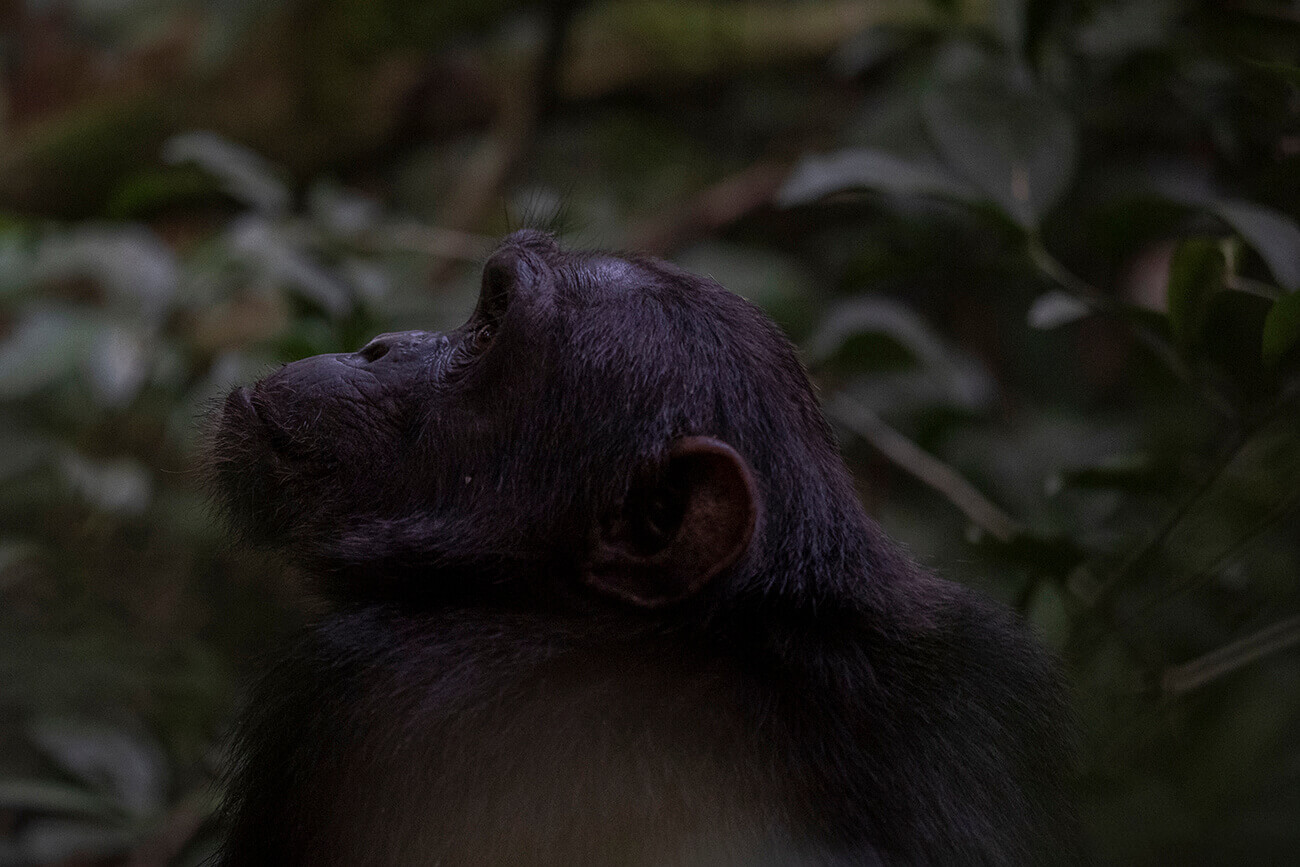
Suddenly, Edison stopped and pointed silently toward a dark figure. Even though the light was still low, there was no doubt — it was a chimpanzee. Sitting on the ground, it stared at us for a few seconds before disappearing silently into the forest. A typical reaction, especially since this group wasn’t fully habituated to humans yet.
From that moment, the four-hour habituation experience officially began.

Walking Among Chimpanzees in Kibale Forest
The following hours were incredibly intense. We were constantly on the move. The sounds of chimpanzees filled the jungle — distant hoots, screams, and pant-grunts echoing from tree to tree. It was chilling and thrilling at the same time.
Based on where the sounds came from and the type of call, Edison decided the best route to locate more chimpanzees. The group we were following was believed to have around 70 individuals.
Most encounters were brief. When we spotted a chimpanzee, it rarely stayed still for long. If one moved away, we didn’t follow it — instead, we shifted direction and tried to locate another one nearby. Occasionally, a chimpanzee would tolerate our presence for a few minutes, watching us with curiosity before moving on.
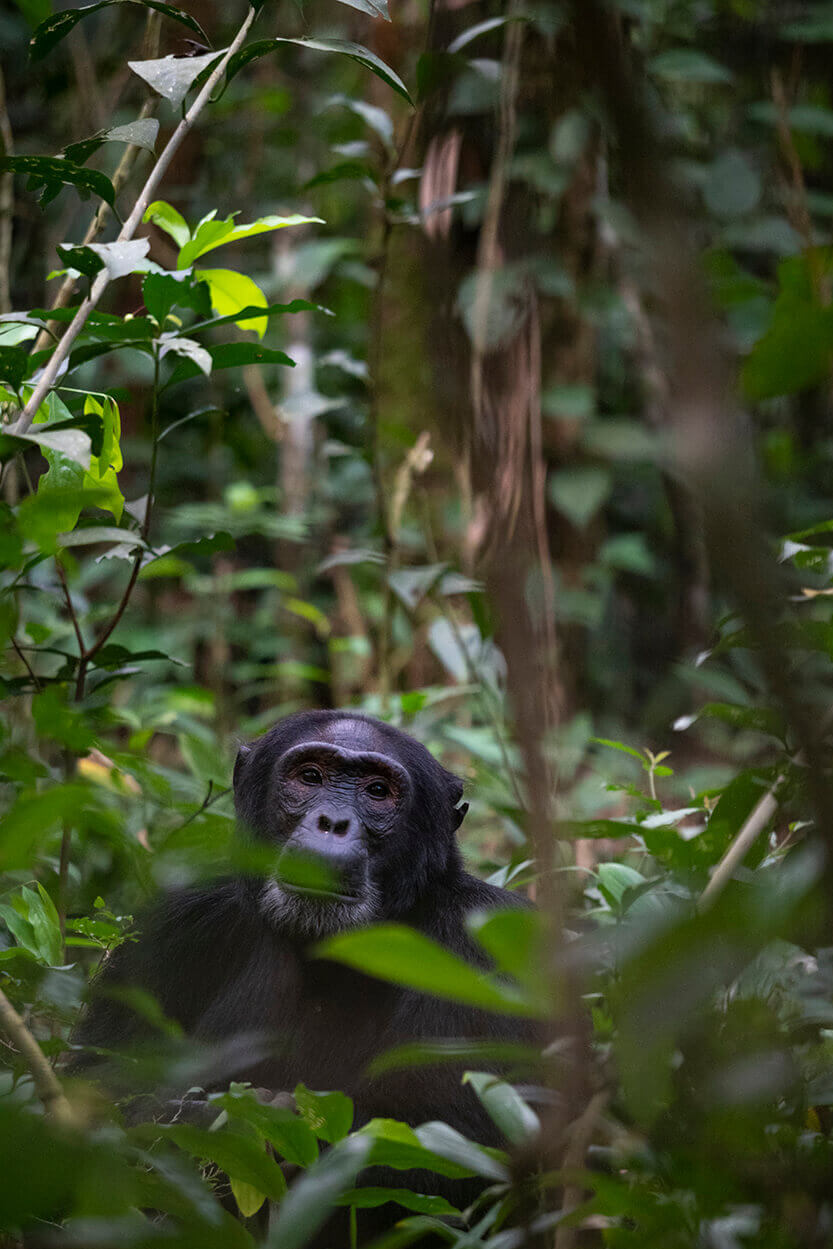

Not all chimpanzees were on the ground. I also saw quite a few chimpanzees high in the trees, moving with incredible agility through the canopy. Some remained still, peacefully feeding on forest fruits, perfectly camouflaged among the dense vegetation.


Exactly four hours after we had spotted the first chimpanzee, our guide signaled that the activity was over. It was time to leave.
I had no idea where we were. I was completely disoriented — deep inside the forest, with no visible path or landmarks. Luckily, our ranger knew the forest like the back of his hand, and soon he found a trail that led us out of the jungle.
By the end of the experience, I had walked over 12 kilometers through thick rainforest, most of it off-trail. It was physically demanding but one of the most magical nature experiences I’ve ever had. Seeing wild chimpanzees in their natural environment, while their calls echoed through the treetops, was absolutely unforgettable.

Plan Your Trip to Uganda
🦍 Find the best trips and safaris to Uganda with a local operator here.
✈️ The best flight deals to Uganda here.
🏨 The best prices for accommodations in Uganda here.
🚑 Get your travel insurance with a 7% discount here.
💳 The best card for paying (without fees) and withdrawing money abroad here.