Encountering mountain gorillas in Uganda is an experience that’s hard to put into words. In this Uganda gorilla trekking guide, you’ll find everything you need to plan this unforgettable adventure.
There’s something truly special about standing in the middle of the Ugandan jungle, just a few meters away from a family of mountain gorillas as they interact with one another. You’re only allowed to spend one hour with them, but it’s one of the most intense and unforgettable hours you can experience in the wild.

Uganda or Another Country: Where to See Gorillas?
Mountain gorillas are a critically endangered species, with only 1,063 individuals left in the wild. These majestic animals can only be found in three countries: Uganda, Rwanda, and the Democratic Republic of the Congo (DRC).
For most travelers, Uganda is the top choice — and for good reason. It offers the best balance between permit cost and travel safety.
In terms of security, visiting the DRC is not currently recommended due to ongoing violence and instability. Meanwhile, both Uganda and Rwanda offer relatively safe conditions, making gorilla trekking much more accessible.
When it comes to cost, Rwanda is by far the most expensive destination: gorilla permits are priced at $1,500 USD. In Uganda, the cost is more affordable at $800 USD. The DRC offers the cheapest permits at $400 USD, but with the highest travel risks.

Where to Go Gorilla Trekking in Uganda
There are two national parks where you can go gorilla trekking in Uganda: Bwindi Impenetrable National Park and Mgahinga Gorilla National Park.
Bwindi Impenetrable Forest (a UNESCO World Heritage Site) is home to half of the world’s population of mountain gorillas. There are 18 gorilla families that have been habituated to human presence, and these are the ones visited during treks. Since the park is much larger, there are four different sectors where treks can begin: Buhoma, Ruhija, Rushaga, and Nkuringo. The sector is specified on the permit you receive when you book and pay the $800 fee.
On the other hand, Mgahinga Gorilla National Park is the smallest national park in the country. It is located within the iconic Virunga Massif, right on the border with Rwanda. There are only two habituated gorilla families here: the Nyakagezi and the Hirwa. The Nyakagezi family is the only one visited on a regular basis.
The experience in both parks is very similar. However, Bwindi Impenetrable National Park is much more famous because it is closer to Queen Elizabeth National Park and to Entebbe. Also, since there are more habituated gorilla families, it can accommodate more tourists.
I chose to visit Mgahinga Gorilla National Park for two reasons. I was especially excited to observe mountain gorillas in the Virunga Mountains, where George Schaller and Dian Fossey contributed to the study and conservation of the species. Additionally, Mgahinga is the only national park in Uganda where you can see the golden monkey, a primate endemic to the Virunga Massif.


Price of Gorilla Trekking in Uganda
As you can read in my post about Uganda safari costs, seeing gorillas in Uganda is an expensive experience. The trek to see mountain gorillas—whether in Bwindi Impenetrable National Park or Mgahinga Gorilla National Park—costs $800 USD. The good news is that this money greatly contributes to the conservation of this endangered species.
In addition, it is customary to tip the trackers, rangers, and the guide at the end of the activity. It is recommended to give around $10 to be shared among the trackers, $10 to the guide, and $10 to each ranger.
You also need to factor in the cost of transportation and accommodation. You can travel by rental car (the most basic options cost around $50 per day); by rental car with a driver (add about $40 more per day); or through a tour agency. Budget accommodations cost around $25 for two people.
If you’re traveling with a tour agency, it’s best to book directly with a local company. You can use this form I created to connect travelers with trusted local agencies. If you’re only booking a gorilla trekking tour, it usually lasts three days and costs a minimum of $1,400 USD (including the $800 permit). If you have more time, it’s worth extending your trip and booking a tour of 7 to 12 days. In that case, the cost typically ranges from $250 to $350 USD per day and also includes the $800 permit.

How to Book the Permit to See Gorillas in Uganda
Having booked and paid for the permit to see gorillas in Uganda is essential to be able to do this activity. Since the number of permits is limited, it is recommended to obtain the permit as soon as possible. If you travel during the low season, about 3 months in advance is usually enough; and if you travel in the high season (from June to September), it is better to do it about 5 or 6 months in advance.
The permits are managed by the Ugandan Wildlife Authority (UWA), but I do not recommend making the reservation and payment directly with them. They are very inefficient at responding.
If you are traveling with a local Ugandan operator, they will take care of everything. They will only need your passport and advance payment.
If you decide to travel independently to Uganda, you can ask the car rental company if they usually handle this; some accommodations also do; or, alternatively, you can look for a local agency solely to handle this process.


What is the Best Time to Experience Gorilla Trekking?
Gorilla trekking is available every day of the year in both Bwindi Impenetrable Forest and Mgahinga. Additionally, the chances of seeing gorillas are generally very high throughout the year, although it is never guaranteed.
If possible, it’s best to choose the dry season months. Walking through the forest and observing mountain gorillas without rain is much more enjoyable. Generally, the driest months in Uganda are June, July, August, January, and February.

What to Bring for Gorilla Trekking?
Gorilla trekking in Uganda requires walking through forest areas with steep slopes and often without any trails. Also, the duration is uncertain, as it depends on how long it takes to find the gorillas. Sometimes they are found in less than an hour, but on other occasions, it may be necessary to walk up to seven hours to locate the primate family.
For this reason, it is necessary to be well prepared with appropriate trekking gear. Here are some essentials:
- Good hiking boots, preferably high-cut.
- Long socks (outside the pants) or gaiters to prevent ants or other insects from entering under the pants.
- A backpack with water (at least two liters) and food in case the trek takes longer.
- A raincoat.
- A face mask (during the hour spent observing the gorillas, wearing a mask is necessary to prevent disease transmission).
- Mosquito repellent and sunscreen (important to apply before starting to walk).
- A cap or hat.
For those less accustomed to walking, a porter can be hired before the trek. Besides carrying the backpack, they can be very helpful for overcoming steep or slippery sections. This service costs $20 as a base fee, plus any tip you wish to add.
💡 Get a Free Quote for Your Trip to Uganda with Trusted Local Operators
If you’d like to plan your trip to Uganda with reliable local tour operators, I can help you connect with the best ones. Just fill out this quick form, and based on the type of safari you’re looking for, I’ll match you with the most suitable local agencies. I’ll also be available to answer any questions throughout the planning process — so your safari will be stress-free, authentic, and truly unforgettable!


Tips for Responsible Gorilla Trekking in Uganda
The activity of seeing gorillas in Uganda is highly regulated to ensure the animals’ well-being. At most, eight people can visit one gorilla family daily and spend only one hour with them. Throughout the activity, you are accompanied by a guide and two park rangers, who are armed in case of encounters with elephants, buffaloes, or poachers.
Additionally, a group of trackers is responsible for locating the gorilla family. It is also ensured that an adequate safety distance is maintained during the gorilla observation.
Before starting the trek, the rangers explain all the rules in detail. Some of the main points are:
- You can only spend 1 hour observing the gorillas.
- It is necessary to try to maintain a distance of seven meters from the gorillas. If the gorillas approach closer, it is best to stay still and follow the instructions of the rangers and trackers.
- You cannot touch the gorillas.
- Photographs must be taken without flash.
- It is important to speak quietly throughout the trek, especially when in front of the gorillas. It is also essential not to imitate the sounds gorillas make or make sudden gestures.
- You cannot drink water, eat, or smoke during the gorilla observation.
- Avoid direct eye contact with the gorillas.
- Details of a silverback gorilla eating leaves during the gorilla trekking in Uganda
Where to stay before this activity
The gorilla trekking experience in Uganda is one of the country’s most famous, and there is a wide range of accommodation options in the two national parks where this activity can be done.
If you are trekking in Bwindi Impenetrable National Park, it is recommended to find accommodation close to the assigned sector, since the activity starts very early in the morning. Here are some highly rated options:
- Bwindi Forest Lodge (Buhoma sector)
- Gorilla Mist Camp (Ruhija sector)
- Broadbill Forest Camp (Ruhija sector)
- Rushaga Gorilla Lodge (Rushaga sector)
- Chameleon Hill Lodge (Nkuringo sector)
If you are trekking to see gorillas in Mgahinga Gorilla National Park, as I understood during my experience, the park entrance gate is decided the night before based on the location of the Nyakagezi family. Also, in this case, all sectors are closer together. Some recommended places to stay are:
My experience: seeing gorillas in Mgahinga Gorilla National Park (Uganda)
From Queen Elizabeth National Park to Lake Mutanda
After the last night in Queen Elizabeth National Park, I started the journey toward Mgahinga Gorilla National Park. There, the next day, I would do the activity I had been dreaming about for a long time: the gorilla trekking.
According to my Uganda trip plan, I was supposed to head south passing through the Ishasha sector of Queen Elizabeth National Park. However, my guide told me that the road conditions were quite bad and that driving to Mgahinga National Park through Ishasha would make us very late. I doubted whether he said that because of the road or to avoid paying the park entrance fee, but I decided to trust him. I was happy with how my trip in Uganda was going, and it was true that even if I passed through Ishasha, I would have very little time for a safari there.
So, I ended up going south on the main road, outside the national park. However, I still managed to see a couple of elephants, the best way to say goodbye to safaris in Uganda.
The car journey was quite long—about seven and a half hours, stopping for lunch at a local restaurant in Kabale. I think there was some issue with my accommodation, and we ended up going to Mutanda Lake Resort. It was somewhat far from the entrance to Mgahinga National Park (an hour and a half by car), so I would have to get up early the next day. But that wasn’t a big problem.
I was able to enjoy the afternoon with fascinating views of Lake Mutanda and the Virunga massif in the background. A postcard-perfect landscape.


The journey to Muhabura Gate
How long had I been dreaming of seeing mountain gorillas? How many times had I looked at trips to Uganda thinking about living this experience? Today was finally the day.
At 6:30 in the morning, we were already leaving the hotel to go to Muhabura Gate of Mgahinga Gorilla National Park, where the gorilla trekking would begin to see one of the most endangered primates in the world. The car ride there felt endless. There were many rocks on the road, and we moved slowly. Luckily, we had plenty of time.
We had to leave the car in the parking lot of Mount Muhabura Lodge. You can only reach Muhabura Gate on foot, at about 2,200 meters altitude. It was a ten-minute uphill walk, which was good for me to sweat a bit and release the tension of the moment.
The start of the gorilla trekking
At the park entrance, I met the guide and the two rangers who would accompany the group. After checking permits and passports, they explained the activity and the rules we had to follow. They also introduced us to the mountain gorilla family we would try to see. It was the Nyakagezi family, the mountain gorilla family with the most silverbacks. Specifically, they told us it was a family of 9 members: 4 silverback males, 2 adult females, 2 juveniles, and one infant.
Before starting the Uganda gorilla trekking, a group of local community people came and gave us traditional chants and dances. It was an emotional moment and the prelude to a magical experience on my trip to Uganda.


Walking through Mgahinga Gorilla National Park
Finally, the moment to start walking arrived. The group was led and closed by the rangers, who were armed. The guide was second in line and, besides sharing curiosities about the jungle, he also made sure the group stayed together and took the necessary rest breaks.
We moved at a fairly slow pace, stopping constantly. We were all uncertain about whether we would see the gorillas. The trackers who had gone out more than an hour earlier still had not located them.
Half an hour later, the guide’s phone rang: the trackers had found the gorillas. We already knew the direction to go. Also, they were quite close. We walked a few minutes in the direction they had indicated, and when the trackers heard us, they started making noises so the guide could locate them.
After a small climb through the jungle, I found myself just a few meters away from a female mountain gorilla…


Fulfilling the dream of seeing gorillas in Uganda
From the moment the whole group arrived at the area where the mountain gorillas were, the countdown began: we had exactly one hour allowed to be there.
Those sixty minutes were incredibly emotional and flew by. After seeing one of the females, one of the trackers took us to one of the silverback males. A huge specimen that, after looking at us with indifference, laid down to sleep. Quickly, I noticed behind him the only baby of the family, jumping from branch to branch and playing with its two siblings.


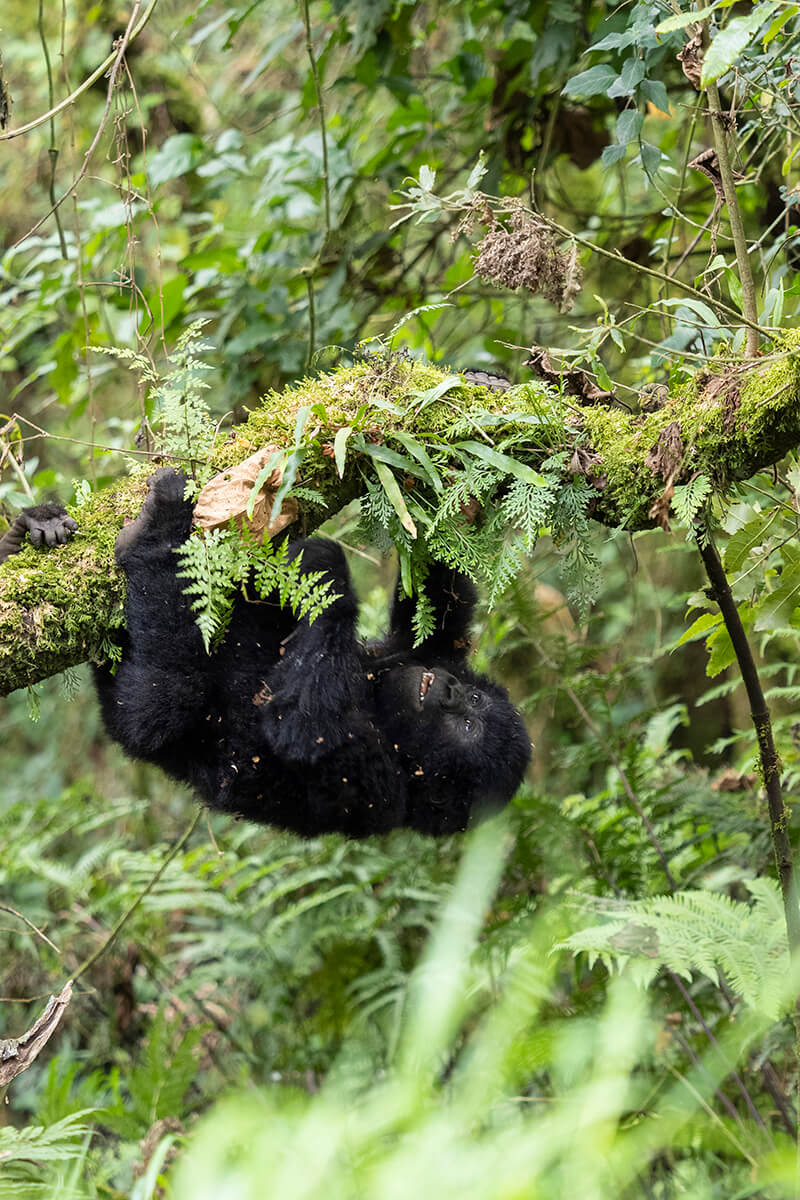

Later, we moved closer to an area where there was another male and two females. They were about five meters away, as dense vegetation and the uneven terrain prevented us from being farther. At all times, I had to position myself where the trackers indicated — the people who know this gorilla family best.


While photographing one of the females, she started moving toward me. A tracker whispered not to move, so I stayed still. The gorilla passed right by me while I remained motionless.
During the last part, I observed and photographed two of the silverback males eating calmly in a rather inaccessible area. The steepness of the terrain and thick vegetation made it difficult to get a good position to see them clearly. This complicated the photos a bit but did not diminish the magic of the moment.

Suddenly, the guide alerted me that the hour had passed. It was time to leave.
With a mix of sadness and immense gratitude, I retraced my steps to grab my backpack and begin the descent back to the park entrance.
I left Mgahinga Gorilla National Park very happy. Not only had I fulfilled one of my travel dreams, and had the chance to see several mountain gorillas up close, but also, with the money I paid for this activity, I was actively contributing to the conservation of this species. It was a perfect example of sustainable tourism with a positive impact.
I ended the day at the historic Travellers Rest Hotel — a place where the researcher George Schaller had also stayed, and which served as a refuge for Diane Fossey when she had to flee the Congo.
Plan Your Trip to Uganda
🦍 Find the best trips and safaris to Uganda with a local operator here.
✈️ The best flight deals to Uganda here.
🏨 The best prices for accommodations in Uganda here.
🚑 Get your travel insurance with a 7% discount here.
💳 The best card for paying (without fees) and withdrawing money abroad here.